
Fire Safety Standards: EN, NFPA and ISO
22 July 2026
Fire Safety Project Planning: 8 Coordination Steps
26 July 2026
- A Risk Assessment Is More Than an Equipment Count
- Prioritise Interface Failures
- Use Scenarios to Set Priorities
- What a Useful Technical Enquiry Contains
- Turn Findings into Owned, Verifiable Actions
- Specifier and Project-Team Checklist
- Common Coordination Mistakes
- Official References and Currency Note
- Frequently Asked Questions
The most dangerous defect is often not a missing device but a broken interface between devices that appear healthy in isolation.
This guide frames risk around people, scenarios and protection layers, with special attention to curtain obstructions and smoke-control coordination.
A Risk Assessment Is More Than an Equipment Count
A credible fire-risk assessment considers ignition sources, fuel, occupants, building layout, work processes and the condition of protection measures. Counting extinguishers or checking an alarm panel does not explain how smoke could move through an atrium, whether a compartment opening is protected or whether a deployed curtain would conflict with an escape route.
The assessment should identify credible scenarios and the people or assets exposed. It can then evaluate prevention, detection, evacuation, suppression, compartmentation and smoke control as layers. Findings should describe the observed condition, the consequence, existing safeguards, recommended action, owner and priority rather than using an unexplained numerical score.
Prioritise Interface Failures
Complex buildings often fail at interfaces: a curtain is obstructed by a later fit-out, a fire door is held open, a fan runs without the intended make-up air, or an alarm output no longer reaches the correct control panel. Scenario-based inspections expose these weaknesses more effectively than isolated visual checks.
Actions should be proportionate and traceable. Immediate life-safety defects need prompt control; design questions may require the appointed fire engineer; product concerns may require the manufacturer’s evidence; and changes to an approved strategy may require authority review. The assessment itself should not be presented as design approval.
Use Scenarios to Set Priorities
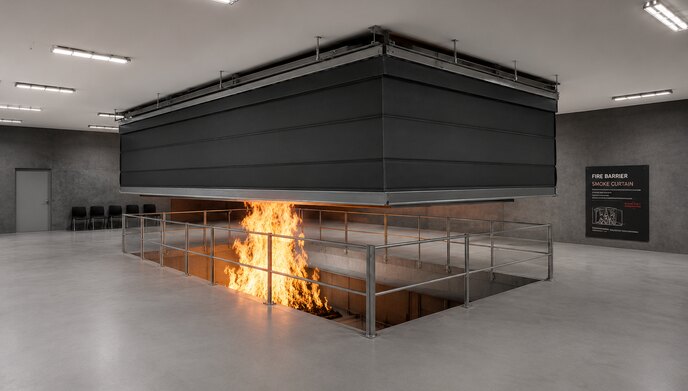
Consider a mall atrium where a deployable smoke curtain is blocked by a promotional sign. The immediate issue is not cosmetic: smoke may cross the intended reservoir boundary and reduce the effectiveness of extraction. The assessment should identify the obstruction, affected scenario, temporary control, responsible team and verification action after removal.
In an industrial building, a fire curtain may appear operational during a local push-button test but fail to receive the alarm signal intended by the cause-and-effect matrix. That is an interface defect. A scenario test involving the initiating device, panel, curtain controller and final-position feedback provides stronger evidence than isolated movement.
Risk ratings should support decisions, not hide them. Explain why likelihood and consequence were assigned, distinguish observed facts from assumptions and state where specialist design review is required. Reassessment should follow significant layout, occupancy, process or fire-strategy changes, as well as completion of major remedial work.
What a Useful Technical Enquiry Contains
A useful enquiry identifies the project country and authority, building use, opening schedule, plans and sections, required classification and duration, mounting substrate, ceiling constraints, control cause-and-effect and programme. Include the relevant specification clauses and any preferred evidence format. This information allows the manufacturer to flag application limits, interface risks and missing decisions before price becomes the only comparison. If requirements are still being developed, mark assumptions clearly and assign the design team to confirm them; a supplier proposal should not silently become the project fire strategy. State whether installation, access equipment, power wiring, alarm interfaces, commissioning, witness testing and operator training belong to the curtain package so quotations remain technically comparable.
Turn Findings into Owned, Verifiable Actions
Every finding should name the condition, consequence, interim control, responsible owner, target date and verification method. Design or compliance decisions should be referred to the appointed competent parties.
Specifier and Project-Team Checklist
- Record the adopted code basis, authority requirements and project-specific fire-strategy objective before selecting a product.
- Define the required classification, duration, dimensions and field of application for every curtain location.
- Coordinate structure, head-box space, guides, finishes, services, power, controls and safe maintenance access on shared drawings.
- Verify that test and classification evidence covers the proposed assembly rather than a similar marketing name.
- Write the alarm, power-loss, manual-control, delay, reset and status-feedback logic into the cause-and-effect matrix.
- Witness integrated tests, close deviations and hand over as-built drawings, evidence, test records and maintenance instructions.

Common Coordination Mistakes
Treating a catalogue as the design
Product literature can describe a system, but it does not establish the project objective, authority acceptance or application limits.
Reviewing disciplines in isolation
A curtain package touches architecture, structure, electrical controls, fire alarm, smoke control and operations. Late coordination creates avoidable risk.
Accepting evidence by headline only
A test duration or certification logo must be traced to the exact assembly, classification, dimensions and installation arrangement.
Official References and Currency Note
A catalogue statement is not a project approval. Confirm the adopted code, the current standard edition, the approved fire strategy and the exact scope of the product evidence.
- BSI — BS EN 12101-1 smoke barriers
- NFPA — NFPA 92 Smoke Control Systems
- ISO — Smoke and heat control committee
This article is general technical guidance, not a project-specific compliance decision. The authority having jurisdiction, appointed fire engineer, approved fire strategy and current product evidence govern the final design.
Frequently Asked Questions
Can one curtain satisfy both fire and smoke objectives?
Only when the specified assembly has the appropriate evidence for the required functions and the approved strategy uses it within that scope. A smoke-only barrier should not be assumed to provide fire resistance.
Who approves the final curtain application?
The answer depends on jurisdiction and contract roles. The appointed fire engineer, project designers and authority having jurisdiction determine the strategy and acceptance; the manufacturer supplies system evidence and technical data.
What information is needed for a curtain proposal?
Provide drawings, opening dimensions, required classification and duration, mounting conditions, control cause-and-effect, project location, programme and any authority or specification requirements.
How should future building changes be managed?
Protect curtain drop zones and smoke-reservoir boundaries in the building change-control process. Review fit-out, signage, ceilings and services before work is approved.
Send the opening schedule, drawings, required classification and control cause-and-effect. IMFire can review the curtain interface and prepare a project-specific proposal.
