Aerosol Fire Suppression: A Specifier’s Review
12 September 2026
Fire Safety in Metro Structures, Transformer, Generator and Electrical Rooms
13 October 2026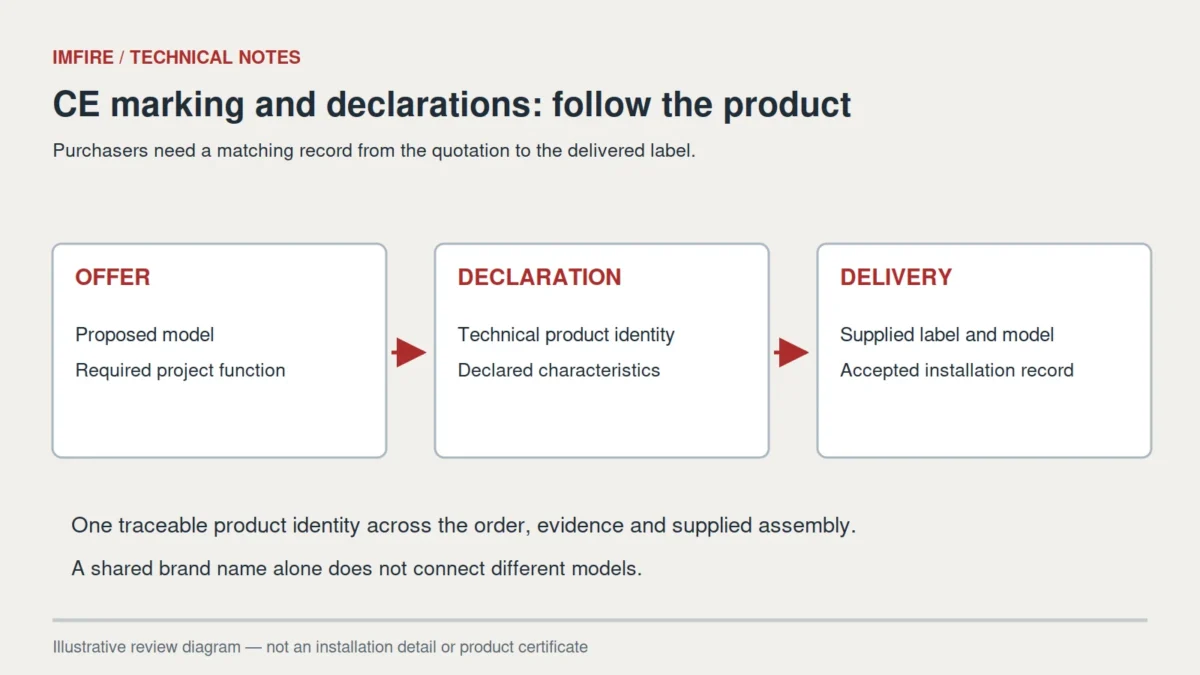
- What a CE mark tells the purchaser
- Read the declaration against the project requirement
- Account for the CPR transition in 2026
- Work through a model mismatch before accepting the offer
- Check delivery and substitutions against the accepted record
- Ask for a usable evidence pack
- Frequently Asked Questions
A CE mark on a label is the start of a purchasing check, not the end of a fire-safety review. The useful question is whether the supplied product can be traced to the right declaration, technical evidence and installation conditions for the project. A document headed “CE certificate” may not answer that question.
For construction-product purchasers, CE marking and a Declaration of Performance, or DoP, need to be read alongside the applicable regulatory route. This article follows the documents from an offer to the delivered assembly. It focuses on identity and declared performance; the separate EN, NFPA and ISO standards guide explains how to organise the project’s technical standards.
What a CE mark tells the purchaser
CE marking indicates the manufacturer’s responsibility for conformity with the applicable EU product rules. It is not a certificate issued by one central EU approval office. The EU’s official CE marking guidance also makes clear that the required assessment route depends on the product. Where a notified body is required, its role must be understood within that route rather than assumed from the presence of a logo.
For purchasing, begin by identifying the product and the legislation claimed to apply. A control component can have conformity documentation for its own functions without that documentation establishing the fire performance of a complete curtain assembly. Ask what the document covers: a component, a defined assembly or a different product in the same manufacturer’s range.
Keep the commercial name and the technical identifier side by side. Brand names can remain similar across several models, while the declaration identifies a particular product type. If the offer and document use different names, request the manufacturer’s traceable explanation before treating them as equivalent.

Read the declaration against the project requirement
Under the established CPR-2011 route, a construction product covered by a harmonised standard or conforming to a European Technical Assessment generally requires the manufacturer’s Declaration of Performance, subject to the regulation’s provisions and exceptions. The text of Regulation (EU) No 305/2011 is the primary source for that framework. Confirm the route applicable to the particular product rather than assuming every fire-safety item has the same declaration requirement.
Look for the product identity, intended use, manufacturer, relevant technical specification and declared characteristics. Then compare the performance actually declared with the opening or application schedule. A declared characteristic is useful only when it answers the project requirement being assessed. Do not read an undeclared characteristic as a pass, or treat one performance classification as automatically demonstrating another.
The installer also needs the conditions that connect the supplied assembly to its evidence. Dimensions, support, components, guides and installation arrangement can matter to a curtain application. Keep the classification and applicable field-of-application information with the manufacturer’s installation instructions. A declaration cannot make an unreviewed site modification acceptable merely because the original product carries CE marking.
Account for the CPR transition in 2026
The new Construction Products Regulation, Regulation (EU) 2024/3110, introduces a Declaration of Performance and Conformity, often shortened to DoPC. Much of the regulation became applicable on 8 January 2026, but the transition is not a single-date replacement of every existing product document.
The European Commission’s transition guidance explains that product families move to the new framework individually. Products covered by standards cited under CPR-2011 can remain under that framework while the relevant transition is pending. New performance harmonised standards cited under CPR-2024 bring the affected families into the new route.
The practical purchasing question is therefore: which framework and cited technical specification govern this product when it is placed on the market? Ask the supplier to identify that basis. Do not reject a DoP solely because it uses the older framework, or accept a document renamed DoPC without checking the underlying route. Keep the answer with the offer and revisit it if the supplied product or governing specification changes.

Work through a model mismatch before accepting the offer
Consider an illustrative enquiry for six curtain openings. The quotation lists Model A, the declaration identifies Model B and the installation sheet has no model identifier. All three documents may be authentic, yet the bundle does not establish what will be supplied or whether the evidence applies. The correct next step is a document-identity query, not a conclusion that the equipment is either compliant or noncompliant.
Ask the manufacturer to reconcile the identifiers in writing and supply the controlled installation information for the proposed assembly. If Model A is a commercial name for the declared product type, the reply should make that relationship traceable. If a different model has been substituted, return it to the technical review against the scheduled requirements.
Now compare the six openings. One might have a different supporting construction or a larger dimension. A document accepted for the others should not automatically be extended to that location. Record the exception against its opening reference, including the information needed to resolve it. This makes the review useful to the purchasing team without expecting a buyer to interpret a technical report beyond their competence.
For a proposed Fire Curtain E240 assembly, use the product page to identify the relevant enquiry and then request the actual documentation for the offered configuration. A website performance description and the project’s reviewed submittal serve different purposes.

Check delivery and substitutions against the accepted record
At delivery, compare the product labels and supplied documentation with the accepted offer and submittal. Record identifiers and any discrepancy before the equipment is incorporated into work that will be difficult to inspect later. A useful goods-received record shows what arrived, the relevant order or opening reference and where its accepted documentation is stored.
Treat substitutions as a documented review. A replacement controller, fabric, guide detail or support arrangement can raise a different question from a corrected spelling on a document. Ask the appropriate technical reviewer to identify the consequence and retain the manufacturer’s response where required. Do not allow a commercial substitution approval to be read as approval of the fire-performance implications.
Keep document revisions visible through handover. The operator needs the accepted installation and operating information for the installed product, not whichever brochure happens to be easiest to download later. Connect the record to the physical asset reference and the curtain maintenance file so future repairs can be checked against the same baseline.
Ask for a usable evidence pack
An efficient request identifies the project jurisdiction, intended use, opening schedule and proposed product. Ask for the applicable declaration, the technical evidence needed to assess performance, controlled installation instructions and a clear account of any limits or deviations. The IMFire contact page provides a route for that technical enquiry.
The buyer does not need an unexplained collection of certificates. The buyer needs a traceable chain from the product on the order to the documents reviewed by the responsible project team. When the chain is incomplete, list the specific gap and the person who will resolve it before release or acceptance.
This article addresses EU construction-product purchasing and was reviewed on 12 September 2026. Other markets can have different marking and approval routes. Recheck the current Commission guidance, legal text and product-specific technical basis when placing an order; CE marking does not itself decide whether a particular installation satisfies the building’s fire strategy.
Frequently Asked Questions
Is a CE mark the same as a CE certificate?
No. CE marking represents the manufacturer’s responsibility under applicable EU product rules. Supporting declarations and third-party documents depend on the product’s regulatory route.
Does every construction product use a DoPC in 2026?
No. CPR-2011 and CPR-2024 coexist during a product-family transition. Check which framework and cited technical specification apply to the particular product.
Does CE marking prove that a curtain suits my opening?
No. The declared performance and relevant assembly evidence must be assessed against the project’s required function, dimensions, support and installation conditions.
What if the model names on the documents differ?
Ask the manufacturer to reconcile the product identifiers in a traceable written response. A shared brand or similar name does not by itself connect the declaration to the offered assembly.
Send the opening schedule, required performance, project jurisdiction and proposed model so the relevant evidence can be identified.