Fire Curtain Design: Fix the Drawing First
25 August 2026
CE Marking and DoP: A Purchaser’s Document Check
12 September 2026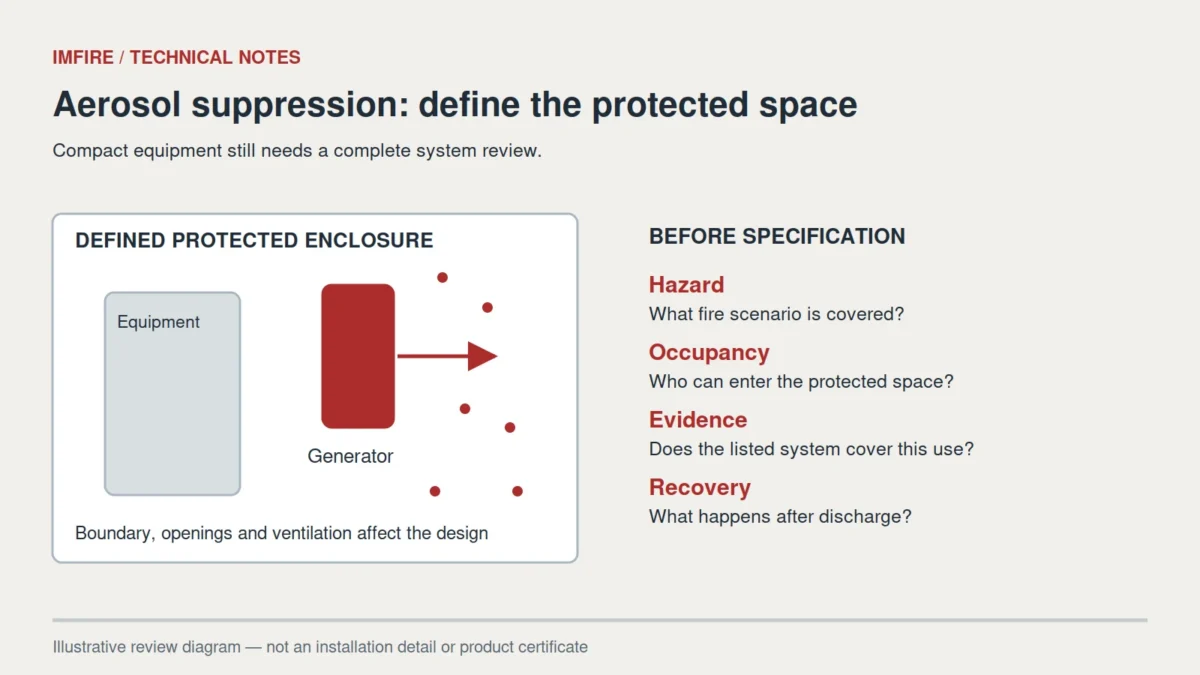
- How condensed aerosol fire suppression works
- Start with the enclosure and the fire hazard
- Treat occupancy and equipment compatibility as separate decisions
- Compare proposals beyond generator size
- Keep suppression and compartmentation in the same project review
- What to resolve before placing the order
- Frequently Asked Questions
Aerosol fire suppression is worth considering when the hazard is enclosed and space for conventional distribution equipment is limited. Its compact generator can be attractive in a cabinet or technical enclosure. The specification still has to answer a harder question: does the proposed system suit the fuel, enclosure, people and equipment actually present?
This guide is for specifiers comparing a condensed aerosol proposal with other protection options. It explains the operating principle and the information needed to judge a proposal. It does not supply a design concentration, generator spacing or a release sequence; those belong to the approved system design and the selected manufacturer’s instructions.
How condensed aerosol fire suppression works
A condensed aerosol generator contains a solid agent-forming compound. Activation starts a controlled reaction inside the unit, producing fine particles carried into the protected space. For commonly used potassium-based systems, the particles interfere with the chemical reactions sustaining the flame. The selected product determines the formulation, activation method and generator construction. FirePro’s explanation of its extinguishing mechanism describes this principle for its own potassium-carbonate system.
That explanation matters when reading an offer. “Does not significantly reduce oxygen” describes an extinguishing mechanism; it does not establish that a discharge is harmless to occupants, equipment or the space. Exposure, visibility, discharge temperature and post-discharge procedures need their own evidence. A manufacturer’s account of its product also should not be applied automatically to every aerosol generator.
Some units are electrically initiated as part of a detection and release system; other models use different activation arrangements. Ask which model is proposed and how its initiating method fits the hazard. Stat-X describes several activation methods across its range. That is a useful illustration of why a specification should name the arrangement rather than saying only “automatic aerosol.”

Start with the enclosure and the fire hazard
Define what is being protected: the inside of a cabinet, a machine enclosure or a whole room. These are different design boundaries. A generator placed inside a cabinet does not automatically protect every space around it; a room arrangement does not automatically reach all shielded volumes inside equipment. Ask the designer to identify the protected volume and any excluded or separately assessed spaces.
Record the fuels, likely ignition sources, equipment operating conditions and ventilation. Doors, cable entries, fans and ducts affect how the enclosure behaves. A normally open panel or an extraction fan that remains running can be relevant to retention and distribution. The response of those openings and systems must be addressed in the accepted design, rather than resolved by an installer guessing how to seal a cabinet.
For an illustrative survey, a room measuring four metres by three metres by three metres has a gross geometric volume of 36 cubic metres. That calculation is only the start of the enquiry. It does not establish agent quantity: connected voids, internal obstructions, leakage, ventilation, the hazard and the selected product’s design method still require assessment. Do not multiply the gross room volume by an online rule of thumb and treat the result as an approved system.

Treat occupancy and equipment compatibility as separate decisions
The term “technical room” does not establish that nobody enters it. Maintenance staff may work inside, sometimes with doors open and equipment isolated. Define normal occupancy and foreseeable access, then check the applicable conditions for the exact agent and application. The US EPA SNAP questions and answers states that powdered aerosols need physiological-effects review to be listed as acceptable in normally occupied total-flooding applications. This is a US regulatory context, not worldwide permission to use a product.
Check the actual entry in the EPA total-flooding agents list when that programme is relevant. Entries and conditions differ by agent. An acceptance status is not a complete building approval, and a condition attached to one agent should not be attributed to all others. The system designer still needs the applicable safety provisions, product documentation and project approval route.
Equipment compatibility asks a different question. What residue can remain, how is it removed, and what inspection does the equipment owner require before restarting? Obtain product-specific cleanup information and ask the equipment manufacturer about the proposed exposure and cleaning method. “Suitable for electrical equipment” is too broad to settle the recovery requirements of every control panel, server or precision instrument.
For lithium-ion batteries or another specialist hazard, request evidence addressing the actual failure scenario. Do not infer control of a battery event from a demonstration extinguishing an exposed flame. Describe the hazard and the required protection objective to the competent designer before comparing technologies.
Compare proposals beyond generator size
Compare the whole supplied system and the work needed around it. Ask who provides detection, release controls, warning arrangements, power, enclosure changes, ventilation interfaces, installation, commissioning and the post-discharge procedure. A compact unit may reduce some physical installation work, but an equipment-only price cannot be compared directly with a complete designed and commissioned package.
Require the proposed system’s listing or certification information, application limits, design manual and calculation basis. The official NFPA 2010 publication page identifies the standard for fixed aerosol fire-extinguishing systems. Confirm the adopted edition and local approval route instead of assuming that mentioning the standard establishes compliance. The reviewer needs to connect the evidence to the exact model and proposed configuration.
The comparison should also cover access and lifecycle costs: inspection, replacement provisions, controls testing, recovery after a discharge and disposal arrangements. Ask for these as defined scope items. A claim of “maintenance-free” can conceal the fact that the detection, controls, enclosure and installation condition still need an appropriate inspection and maintenance plan.

Keep suppression and compartmentation in the same project review
Aerosol suppression addresses a defined fire hazard; the building may also rely on boundaries and other measures to limit fire or smoke spread. Use the active and passive fire protection guide to separate those roles and their interfaces. Do not treat the presence of a suppression generator as permission to remove a fire-resisting enclosure or protected opening.
If an IMFire proposal is being considered, the aerosol systems page is the starting point for product questions. Send the enclosure drawings, hazard description, occupancy, ventilation and relevant project requirements through the technical enquiry route. Identify any missing input explicitly so the proposal shows what remains to be resolved.
Before acceptance, agree what must be demonstrated and recorded for the installed arrangement. The test method should follow the approved design and manufacturer instructions, with competent control of any release-system testing. Retain the accepted calculation, installation information, test records and operating instructions together. This gives the operator a basis for reviewing later cabinet alterations, new equipment or ventilation changes.
What to resolve before placing the order
The purchasing decision should leave no doubt about the protected boundary, the hazards included, the exact equipment proposed and the conditions under which it is intended to work. If one of these is missing, ask a focused technical question and retain the reply with the offer. A shorter offer with clear limits is easier to assess than pages of general claims about speed or safety.
This review is current to 12 September 2026. Check the live official agent listing, adopted standards and current manufacturer documentation when the project specification is issued. The points above support a competent design review; they are not installation instructions or approval for a particular enclosure.
Frequently Asked Questions
Does aerosol fire suppression remove the oxygen?
Common potassium-based condensed aerosols primarily interfere with the flame’s chemical reaction. That operating principle does not establish safe human exposure; check the exact product, design and applicable conditions.
Can one aerosol generator protect any cabinet?
No. Suitability and sizing depend on the defined enclosure, hazard, openings, ventilation, distribution and the selected system’s approved design method and evidence.
Is aerosol suitable for occupied rooms?
Do not assume it. Review the exact agent and system’s permitted use, exposure evidence and required safety provisions under the applicable jurisdiction and project approval route.
Does aerosol leave equipment ready to restart immediately?
Do not make that assumption. Obtain product-specific cleanup information and the equipment owner’s inspection and restart requirements before selecting the system.
Send the enclosure drawings, hazards, occupancy and ventilation details. Include the proposed system and any evidence already supplied.